Blask Analytics: the Brazilian Market

Presenting an analysis of the Brazilian online gambling market, powered by Blask. Exclusively on G GATE MEDIA.
I have 5+ years of experience in iGaming on the product side (with online casinos). I started as a customer support agent and have made my way to Head of Retention.

We are launching a new weekly feature, supported by Blask’s iGaming analytics platform. In these weekly pieces, we’ll take a deep dive into the gambling market trends and the reasons behind them. The country we’ll be looking at today is Brazil.
In this piece, we discuss overall interest in gambling, specific brands and leading iGaming operators, and market changes over the past year.
GEO Overview
The following is key data regarding Brazil’s gambling market, accurate as of November 7, 2025:
- Population: ~220 million
- Population with internet access: ~170 million
- Language: Portuguese
- Average age: 35.1
- Number of legal operators: 148
- Total operators: 552
- Gambling status: regulated
- Regulator: Secretariat of Prizes and Betting (SPA)
Player Profile
Here is the player data reported by Blask in Beta mode, accurate as of December, 2024.
Age groups:
- 18–24: 29%
- 25–34: 25%
- 35–44: 22%
- 45–54: 24%
Income (BRL):
- Under 20k: 10%
- 20–40k: 20%
- 40–60k: 30%
- 60–80k: 25%
- 80–100k: 10%
- 100k: 4%
Primary motivation for sports betting (multiple choices considered):
- To earn money: 71%
- To add excitement to watching sports: 50%
- To have fun: 42%
- To feel the adrenaline rush: 40%
- To pass the time: 35%
Primary motivation for playing casino games (multiple choices considered):
- To earn money: 60%
- To have fun: 35%
- To pass the time: 25%
- To enjoy the readily-accessible games: 25%
- To escape the routine: 20%
Main platforms for iGaming brands’ touchpoints (multiple choices considered):
- Social networks: 60%
- YouTube: 50%
- Online advertising: 45%
- Search engines: 40%
- TV advertising: 35%
Demand for Gambling
The Blask Index is a metric that showcases interest across all gambling brands in a country. It’s based on attributed intent to interact with brands, inferred from user search activity. The chart covers the previous 12 months.
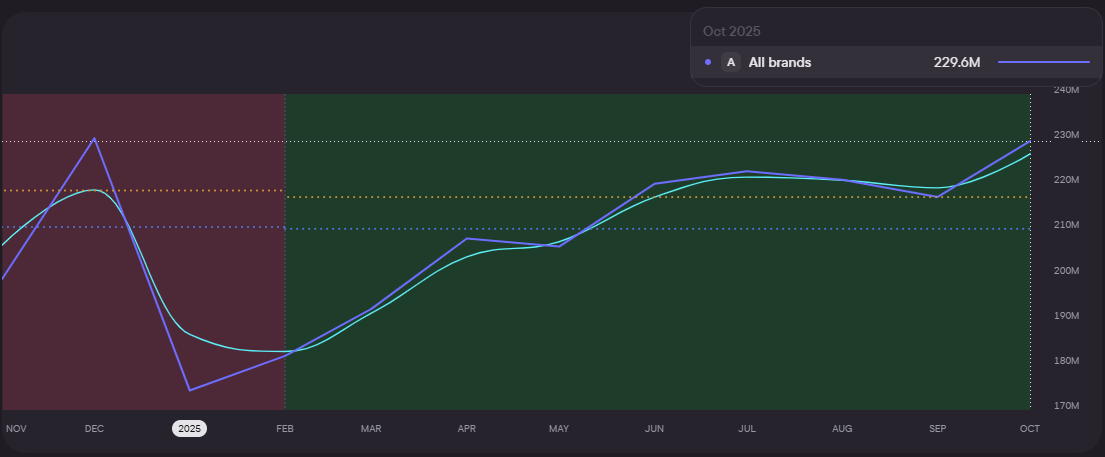
The Blask Index for Brazil as of late October 2025 is 229.6 million. In December 2024, interest fell sharply before market regulation was launched. 11 months later, the figure had nearly recovered to its pre-regulation level of 230.2 million.
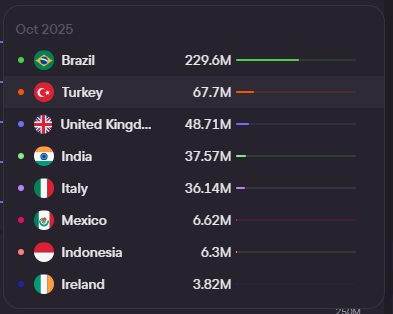
For comparison, Blask Index puts Brazil ahead of India, Mexico, Turkey, Great Britain, Ireland, Italy, and Indonesia as of October 2025.
Even though the market has been recovering since the beginning of the year, it has still experienced a few off-peak periods.
In April 2025, Blask marked a noticeable dip, which could have been caused by a series of newly introduced restrictions:
- New requirements for all operators to register on the consumer dispute resolution website
- The creation of the operator oversight committee
- Measures against illegal financial transactions implemented by national authorities
Since the market had just begun to recover, these new measures could have cooled public interest and discouraged local brands’ marketing efforts.
The decline could also be related to the trial of former Brazilian President Jair Bolsonaro. The process triggered large-scale protests by Bolsonaro’s supporters and activists.
In May, the index showed a steady upward trend, but demand for gambling then dropped for the following two months. The most likely reasons for the contraction were new legislative restrictions and a series of government initiatives during this period.
- The Brazilian authorities planned to introduce a huge retroactive tax for bookmakers.
- Brazil increased the tax on gross gaming earnings to 18% and introduced new rules for the betting sector.
Even Polymarket considered this period of “political turbulence” for the country.
However, interest in gambling has stabilized and nearly returned to the record figures of late November–early December 2024.
Market Trends
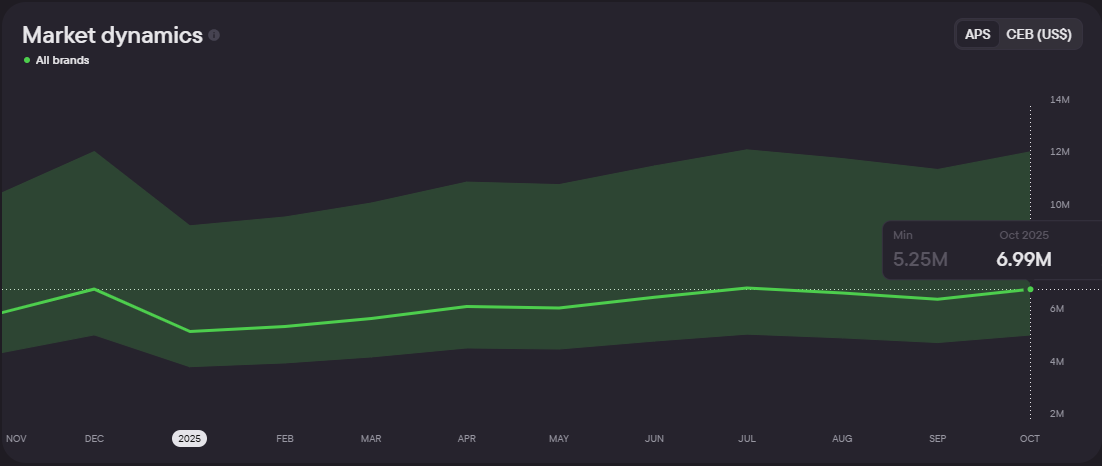
The Acquisition Power Score (APS) and Competitive Earning Baseline (CEB) measure the market performance.
APS measures the projected number of customers. It’s calculated based on the number of projected customers for a completed month per brand.
CEB measures the projected monthly earnings. It’s calculated as the projected monthly earnings per brand for a completed month.
These benchmarks are based on the hourly Blask Index and on public records. At the same time, they are not affected by external factors, such as politics, the economy, and sports events. Hence, the data is provided as a range.
The benchmarks apply to both the market as a whole and to every individual operator. As of late October, the projected earnings of the entire Brazilian gambling market ranged from $535 million to $937 million.
During that period, the projected number of customers ranged from 6.99 million to 12.25 million. The value almost reached the December 2024 level, when the market size varied from 7 million to 12.26 million. This confirms the idea that the market has been on the path to recovery.
Market Leaders
A Brand’s Accumulated Power (BAP) shows a brand’s share in total consumer interest. The chart covers the last 12 months.
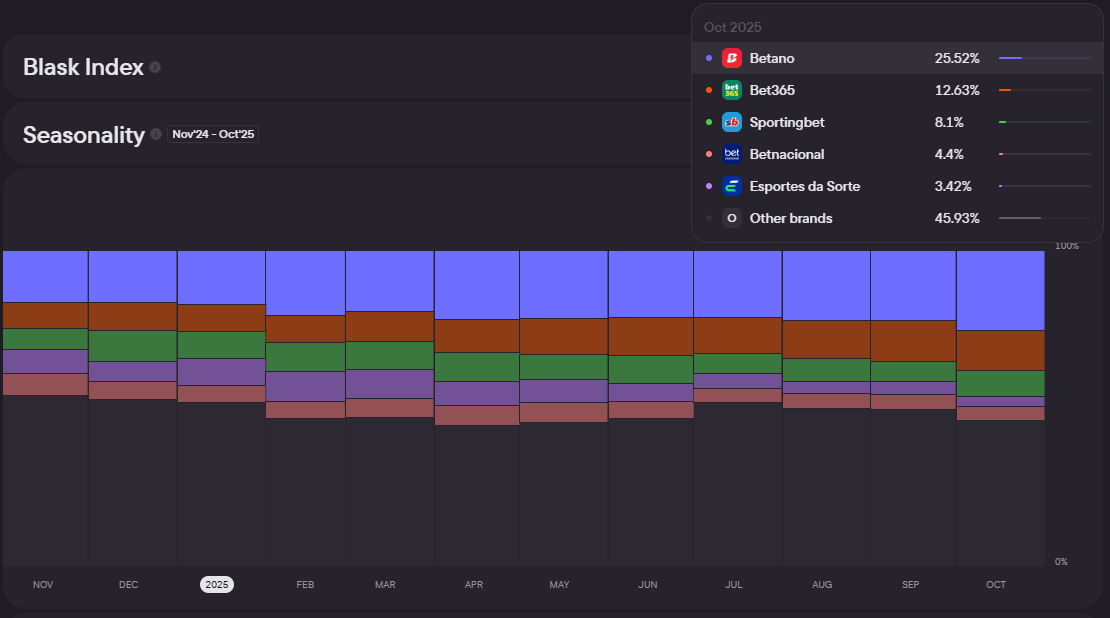
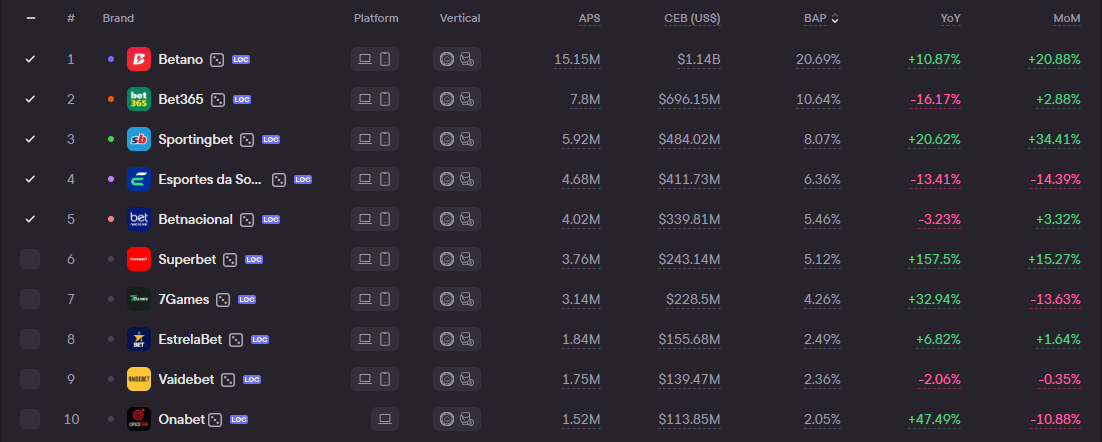
The undisputed market leader is Betano, boasting a BAP of 25.52% along with impressive APS and CEB values. The brand has been dominating the market for more than a year. Over the past year, its Blask Index has risen by more than 10%.
Despite that, the annual growth rates of several other brands are outperforming the leader’s. Superbet’s Blask Index, for example, gained 157.5% over the year.
Seasonality and Active Gambling Days
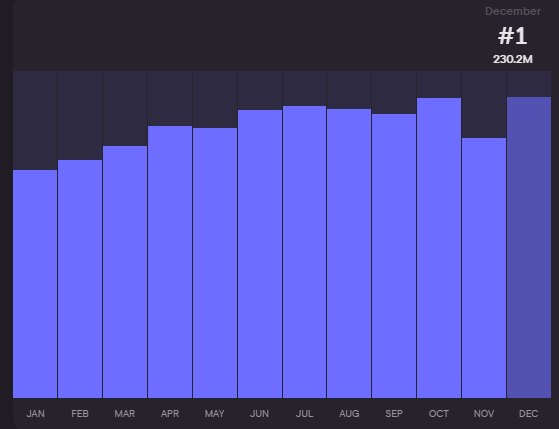
Seasonality accounts for the monthly volume of user activity. The chart is based on the Blask Index. The highest activity month in Brazil is December, with 230.2 million.
The top 5 months are as follows:
- December
- October
- July
- August
- June
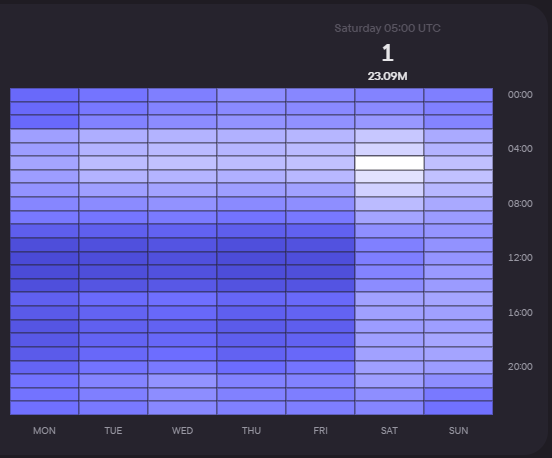
The Brazilians are most active on Saturdays between 11 p.m. and 4 a.m. It’s important to keep in mind that Brazil has four time zones, so the time should be adjusted for each region.
As for weekdays, Tuesday and Wednesday are most active, while the time remains the same. Brazilians are the least active on Mondays.
The period from 7 a.m. to 12 p.m. shows the least activity, regardless of the day of the week.
Slots and Games
Even though crash and casual games have dominated the media, as of November 4, Gates of Olympus 1000 remains the most in-demand slot in Brazil. It’s featured by 189 of the 552 market operators. We can safely conclude that some operators are losing users and revenue by not including this slot in their portfolios.
Aviator by Spribe ranks second and is one of the three crash games in the top ten. It is offered by 165 operators and enjoys greater lobby visibility (AVG Lobby GVR) and overall game page visibility (Avg GVR) than Gates of Olympus. The lower the GVR, the better the game position on the screen and in the lobby. The slot remains a big hit and might even outpace the current favorite.
While Sweet Bonanza 1000 hasn’t performed as well as the other two leaders, it retains a firm spot at the top, leaving no doubt that the title is popular with players.
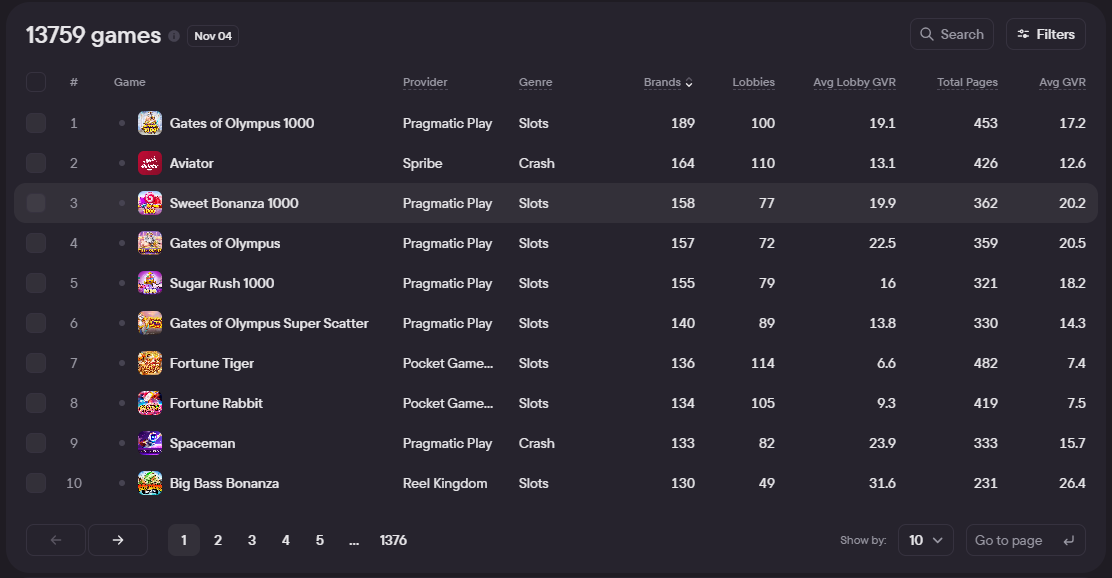
Despite only ranking 7th overall, the iconic slot Fortune Tiger tops the lot in Share of Interest. This is the slot users are most interested in.
Conclusion
The Brazilian market has endured tremendous changes over the past year, riding out multiple highs and lows. Today, we can safely conclude that the country’s iGaming industry has fully recovered, as clearly evidenced by its Blask Index and overall market trends.
Brazil is highly likely to break last year’s record by year-end. That is, unless the authorities make another attempt to throw a wrench into the wheels of their own economy.