The Death of Credit Card Dominance: How Open Banking and Instant A2A Payments Are Changing iGaming


Key Takeaways
- Traditional card processing is becoming unsustainable for iGaming operators due to high fees (2.5%–4.5%), high decline rates (up to 30%), and strict credit bans in major jurisdictions.
- Open Banking and Account-to-Account (A2A) rails move funds directly between bank accounts, cutting transaction costs by 60% to 80% with near-zero dispute risk.
- Instant A2A payments significantly improve user experience by enabling 30-second withdrawals and frictionless mobile deposits via native biometrics (Face ID).
- Markets like Brazil (Pix), Europe (Pay by Bank), and the US (RTP or FedNow) demonstrate a rapid global shift from cards to direct bank transfers as a primary payment method.
- Operators can transition smoothly by auditing current card failure rates, positioning A2A at the top of their cashier, and automating payout flows.
Executive Summary
iGaming cashier teams are running out of patience with traditional card processing. Between high processing fees, strict regulations, and constant payment declines, cards are becoming a headache for operators and players alike.
At the same time, Open Banking and instant Account-to-Account (A2A) payments—like Pix in Brazil, Pay by Bank in Europe, and FedNow in the US—are stepping in. Instead of routing money through card networks and acquiring banks, these solutions move funds directly from a player’s bank account to the operator in seconds.
Here is a breakdown of why card dominance is fading, how direct bank payments work, and why this shift is happening so fast across key global markets.
1. Why Card Processing Is Becoming Too Painful for Operators
Visa and Mastercard built the foundation of online payments, but their network was never designed for high-risk, real-time gambling transactions. Operators are hitting four main walls:
High Fees and Intermediary Costs
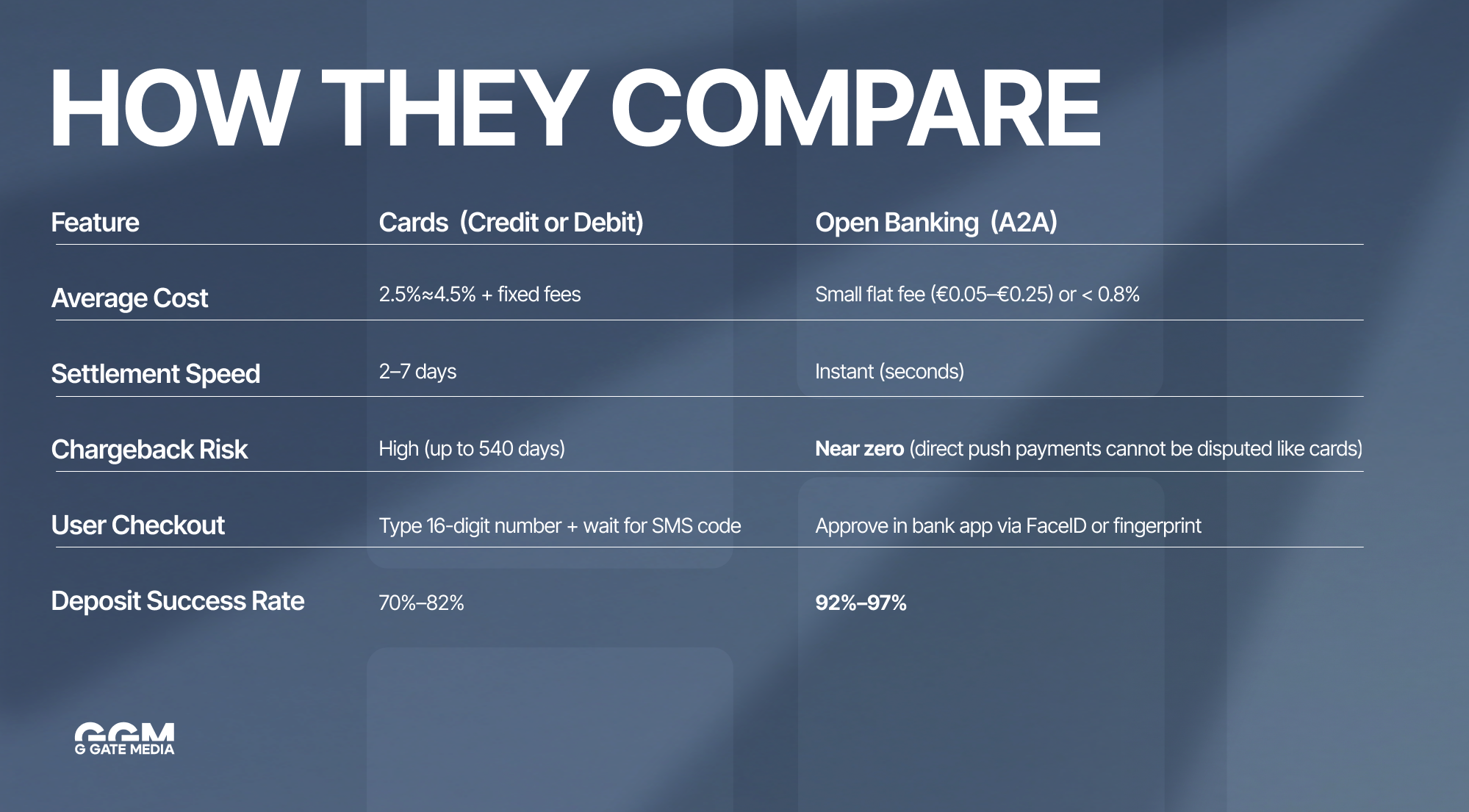
A single card deposit involves a long chain: issuing banks, card schemes, payment gateways, and acquirers. Everyone takes a cut. As a result, iGaming operators often pay 2.5% to 4.5% per transaction just to process a card deposit. In comparison, direct bank payments operate on flat fees—often cutting processing costs by 60% to 80%, according to industry benchmarks highlighted in McKinsey & Company’s Global Payments Reports.
High Decline Rates
Bank algorithms frequently flag gambling deposits coded with MCC 7995 as suspicious. In many regions, 15% to 30% of legitimate card deposits get rejected. The real problem? Payment optimization data from platforms like Stripe reveals that roughly 70% of players whose first deposit fails will simply close the app and never return.
Credit Bans and Regulatory Pressure
Governments are actively cutting credit cards out of online gambling to prevent player debt. The UK banned credit card deposits following extensive assessment by the UK Gambling Commission, and Australia followed suit in 2024. Even in regions where debit cards remain legal, stricter European authentication rules (PSD2 or PSD3) create extra steps that lead to abandoned deposits.
“Friendly Fraud” and Dispute Costs
Card systems give users months to dispute a charge. In iGaming, “friendly fraud”—where a player loses money and tries to claw it back via a chargeback—costs operators millions every year. Managing these disputes wastes time, triggers extra scheme fines, and hurts profit margins.
2. Enter Open Banking: Direct Bank-to-Bank Payments
Account-to-Account (A2A) payments skip the card networks completely. The money travels directly from the player’s bank account into the operator’s bank account.
How They Compare
3. How Different Regions Are Making the Switch
This shift isn’t a future forecast—it is already happening in major markets, as tracked by market intelligence firms like Juniper Research:
- Brazil (The Pix Effect): Brazil’s central bank launched Pix in late 2020. Today, Pix handles over 85% of all iGaming deposits in the country. Card processing for gambling in Brazil has essentially been pushed out because Pix is instant and completely free of friction.
- Europe and UK (Pay by Bank): Over 12 million people in the UK regularly use Open Banking, according to official reports from Open Banking Limited. “Pay by Bank” has moved from a niche option to a primary deposit method. In Europe, SEPA Instant allows operators to offer 30-second payouts, which plays a huge role in player retention.
- United States (RTP and FedNow): US sportsbooks relied heavily on debit cards at first, but high decline rates forced them to look elsewhere. Real-time bank transfer networks (RTP and FedNow) are rapidly becoming the preferred option for both deposits and fast payouts.
4. Why Players Prefer Direct Bank Payments
Players care about two main things: speed and ease of use.
When a player wins, waiting three to five business days for a card payout creates frustration. With Open Banking, withdrawals hit their bank account almost instantly. Data shows that platforms offering instant payouts see up to 35% higher monthly player retention.
The deposit process is also much easier on mobile. Players don’t have to hunt for a physical card, type long numbers, or enter CVV codes. They just tap “Deposit,” confirm the prompt in their mobile banking app using Face ID, and start playing.
5. How Operators Are Making the Transition
Most platforms aren’t dropping cards overnight. Instead, they are taking a stepped approach:
- Auditing current costs: Checking where card decline rates are highest and calculating total spend on processing fees.
- Updating the cashier layout: Placing Open Banking or A2A at the top of the deposit screen as the default “Fast Deposit” option.
- Automating payouts: Connecting instant payment rails to handle routine withdrawals automatically.
- Guiding players: Showing short, helpful UI prompts that explain how quick and easy bank deposits are.
The Bottom Line
Credit cards helped launch online gambling, but they were built for an older era of e-commerce. Modern operators need higher conversion rates, instant settlement, and lower fees. As real-time bank networks grow worldwide, operators that prioritize direct bank payments will save money on processing, reduce fraud, and offer a much better experience for their players.
Got an interesting story or industry insight to share?

Do you have a scoop, an exclusive market study, or a hot topic in the iGaming and fintech space that our readers need to know about? We are always open to expert contributions, guest columns, and media collaborations.
For editorial pitches and media collaborations: Drop a line to our editorial desk at denis_k@gg.group or via LinkedIn.
For commercial partnerships, sponsorships, and advertising: Reach out directly to our sales team at nikolay_s@gg.group or via our LinkedIn.


Verified Sources and References
- Juniper Research: Global A2A Payments Research and Market Forecasts
- Open Banking Limited (OBL) UK: Open Banking Monthly Impact and Adoption Reports
- McKinsey & Company: Global Payments Report Series
- Stripe: Payment Optimization and Friction Reduction Benchmarks
- UK Gambling Commission (UKGC) and NatCen: Evaluation of the Credit Card Ban for Gambling