Betsson Completes €64.5 Million Deal for Rhino’s Canadian Business and Technology Assets
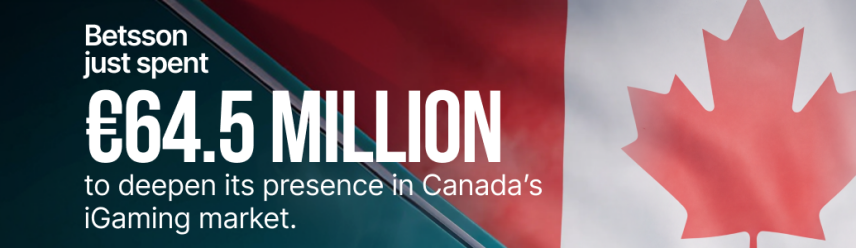

If you can’t beat them, buy them. Betsson’s €64.5 million acquisition of Rhino Entertainment Group’s Canadian business and technology assets is the next step in the iGaming giant’s formula for conquest. Ontario’s intensely competitive market highlights how crucial local familiarity and an established presence are.
Rhino’s Canadian business includes Casino Days, which a sponsored comparison published by the Ottawa Citizen ranks No. 1 overall among online casinos in Alberta. Alberta became the second Canadian province to launch a regulated iGaming market for private operators.
What Betsson Actually Acquired From Rhino
Rhino Entertainment proved itself as a hugely successful iGaming machine, creating a valuable mix of consumer brands, achieving regulatory access in different countries, and crafting valuable, specialized code. The deal transfers an established local team of experts and advanced infrastructure right into Betsson’s global portfolio.
Casino brands
Betsson gained Casino Days, an established Canadian brand. Rhino’s broader portfolio has included:
- Casino Days, its Canadian flagship brand
- Lucky Spins
- Big Boost
- Buusti Kasino
- Big Baazi
- Big Lucky
- Regal Rush
Dual-stream technology for B2B services
The software infrastructure it’s gained in the deal may prove just as valuable as the player brands themselves. Betsson has inherited Rhino’s proprietary front-end and middleware technology, which it can use to improve its own websites. But it can also license the technology to B2B partners. This could generate additional software revenue and give Betsson more operational scale and control.
Clear B2C market and licensing know-how
Rhino brings an established local team and Canadian operational experience into the group. That adds to Betsson’s experience operating Betsafe in Ontario. To operate in Alberta, companies must register with Alberta Gaming, Liquor and Cannabis (AGLC) and sign a commercial agreement with the Alberta iGaming Corporation. Casino Days is already listed as a registered site in Alberta.
Audience segmentation and loyalty under multiple brands
One of the advantages Betsson has pursued consistently is owning brands that appeal to specific audience segments. Building up a following requires understanding the local audience and warming them up to the brand. That’s the power of having separate brands.
Casino Days, with its 3000–6000 games, has a very specific audience. According to Similarweb, direct visits account for 57.5% of its traffic. Some 62% of its visitors are male, mostly around 30. Its game offerings are mostly feature-rich slots, live dealer games, and instant-win games like crash games. It’s connected to the popular payment gateway Interac.
Other brands in Rhino’s broader portfolio have served different audiences:
- Big Boost and Regal Rush serve VIP and high-roller audiences
- Buusti Kasino provides fast Pay N Play mechanics, is licensed in Estonia, and operates in the Baltic region
- Big Baazi was localized for the Indian iGaming market
- Big Lucky operates out of Curaçao and can operate in certain parts of Europe
- Lucky Spins is licensed in Kahnawake and can operate offshore
Betsson’s Business Model
The company has always kept a flexible identity and today operates a light business model that allows it to buy foreign brands and then use its centralized technology platform to power the back end. This system is known as Techsson. Whether a player logs in to a slot machine app in Canada, a sportsbook app in Peru, or a crypto-friendly site in Georgia, every one of those brands plugs into the exact same server network. Today, its largest presence is in Latin America, followed by Central and Eastern Europe.
Betsson goes around the world buying up local brands rather than spreading its name around the world as some big brands do, such as bet365. This helps it save a large share of its expenses because the same team handles fraud across its brands. Operating in different markets also helps diversify against any potential surprises that could cause losses in markets where it already operates.
Some of Betsson’s other acquisitions include:
- betFIRST in Belgium in 2023 for €120 million
- Europe-Bet, a Georgian iGaming operator, in 2015
- Inkabet in 2021 for $34 million
- Zecure Gaming in 2020 for €33 million for the Croatian and Spanish markets
Betsson earns revenue from online gambling and from providing its proprietary sportsbook software, data feeds, and risk management algorithms to smaller, independent casino operators who can’t afford to buy their own technology.
History
The business was founded in 1963 and initially placed physical slots and roulette tables in Swedish restaurants. Betsson knows the importance of having a physical presence and the importance of preserving a spark where it exists, because localization is such a huge factor, especially in iGaming.
Cherry bought Betsson in 2005. Because Betsson’s online B2C platform performed best, Cherry renamed its main company Betsson AB and made Cherry a separate operation to continue operating physical casinos.
Why Canada Is an Important Market for Betsson
Canada regulates iGaming by province. So far, Ontario and Alberta are the only provinces to have opened regulated iGaming markets to private operators.
Other Western markets’ limitations
Europe is one of the most competitive regions for iGaming, and its systems are very mature with very clear regulations, but it also comes with high taxes. Germany and France have some of the highest sports betting taxes on Earth.
Meanwhile, south of the border in the United States, a broad sports betting market is growing, but there is lots of competition. More importantly, though, the expenses for running iGaming are perhaps the most expensive a business will find anywhere. Pennsylvania’s master license costs $10 million, and the rate for online slots is 54% of gross gaming revenue (GGR).
On top of that, operators have to share revenue under agreements with physical casinos. Those agreements are limited in availability and often cover a specific skin or vertical. Operators also have to account for geofencing technology and revenue sharing with other partners.
Where the Canadian market shines
Canada ranks third on the Blask Index for Competitive Earning Baseline. Cognitive Market Research’s gambling market report provides broader market context.
Canada’s $9.5 billion online gambling industry uses provincial revenue-sharing models. Ontario and Alberta calculate their shares differently:
- Ontario’s provincial share is 20% of gaming revenue
- Alberta’s provincial share is 20% of net iGaming revenue after allocations totaling 3% of GGR
Let’s not forget that Canada is a Tier-1 country. Ontario has 16 million people, and Alberta has about five million. Although some revenue sharing will be required for most new operators, it’s a big benefit there that contracts don’t have to be concluded with brick-and-mortar casinos looking to protect their interests. Casinos also operate on First Nations territories, including Kahnawake. In Canada, there has been a different problem—state-run monopolies—but there has been a movement away from that regime.
Canada accounts for about 5.4% of the global gambling market. About 14.3% of Canadian internet users actively participate in monthly online gambling, compared with 10.2% in the U.S. Per-capita gambling spend averages $450. When Ontario launched privately run iGaming, more than 70 casinos received licenses. More than 20 have registered in Alberta.
Next Canadian Provinces That May Open Their iGaming Markets
Other regions of Canada are discussing whether to follow Ontario and Alberta. They’re interested in the tax revenue and concerned about unregulated gray markets. The most active discussions are taking place in New Brunswick, Nova Scotia, and Quebec.
New Brunswick
Here, Finance Minister René Legacy is contemplating how private operators could be regulated in the region to end the long-standing public monopoly held by the Atlantic Lottery Corporation. Citizens there wager 65% of their iGaming spending on gray market platforms. We may see a new bill liberalizing the market in the region.
Nova Scotia
This province is moving right along with its neighbor. John Lohr says the province is exploring an expansion of sports betting and online casinos because of concerns similar to New Brunswick’s. Claudia Chender opposes it.
Quebec
Loto-Québec has held the monopoly here for a long time, and it’s under threat from the Parti Québécois, which wants to help balance the provincial budget, along with support from the opposition Liberal Party. Liberalization here would be a big deal because Quebec, with nine million people, is Canada’s second-most populous province.
Conclusion
Betsson’s €64.5 million acquisition of Rhino’s Canadian business may indeed prove to be a smarter move than it immediately appears. It gives the company an established Canadian brand, technology it can license as a B2B service, and access to new customer segments. Betsson is in a strong position to pursue a larger share of the Canadian market and maybe eventually even give the United States another try.